
编者按
为进一步增强学术交流与智慧融通的深度与广度,南开大学有机新物质创造前沿科学中心依托品牌活动“有机新物质创造前沿论坛(讲座)”,特推出【对话前沿】专家访谈栏目,邀请有机新物质创制领域优秀学者共话科技前沿与未来产业、分享科研体会与创新畅想,希望能够与关注物质科学发展的各界力量共同启迪新思维、新路径,为塑造突破之合力、变革之未来提供碰撞智慧火花的平台。
本期,我们邀请香港中文大学(深圳)Daigo Miyajima教授,围绕研究领域个人选择、杰出成果分享以及对青年科研工作者的期望与寄语等话题进行分享。
01 有机光电材料与合成化学领域
香港中文大学(深圳)Daigo Miyajima教授
dmiyajima@cuhk.edu.cn
1.Could you briefly elaborate on why you have chosen your current research direction as your long-term primary field of study?
In high school, I held a broad fascination with the origin of life, which led me to join Professor Hiroaki Suga’s laboratory at the University of Tokyo immediately after entering university to conduct research on RNA. Through this early experience, I discovered the joy of molecular craftsmanship—designing molecules from scratch and exploring their functions—which inspired me to pursue a career in chemistry. In my senior year, I joined Professor Takuzo Aida’s group, where I studied supramolecular chemistry through the completion of my Ph.D. and became deeply captivated by the structural beauty of molecular assemblies. Today, looking beyond structural elegance alone, I strive to pursue the "functional beauty" of molecular assemblies by developing advanced materials from a supramolecular perspective. Rather than targeting a single specific application, I am driven by the keyword "uncharted"—taking on the challenge of creating unprecedented materials that have never been seen before.
2.Could you briefly talk about one or several research works of which you are most proud?
I have reported several major breakthroughs in the study of one-dimensional hydrogen-bonded supramolecular polymers (Science 2012, Science 2015, Nat. Chem. 2017, Nat. Mater. 2022). Among these, I would like to introduce our pioneering work on the first chain-growth supramolecular polymerization (Science 2015), as it represents a truly beautiful fusion of supramolecular chemistry and polymer chemistry.
1.Why Precision Supramolecular Polymerization Was Difficult (Figure 1)
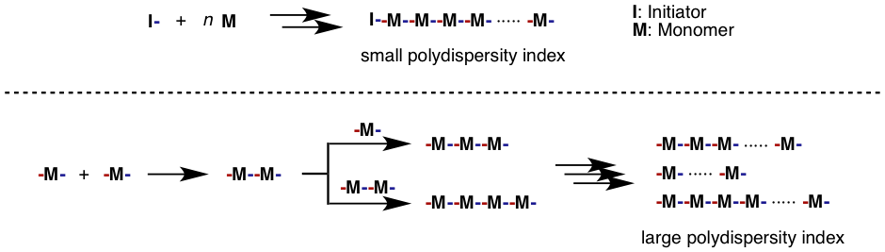
Figure 1. Schematic comparison between precision polymerization of covalent polymers using an initiator (top) and conventional supramolecular polymerization (bottom).
Chain-Growth Polymerization of Covalent Polymers (Figure 1, top):
In conventional covalent polymer synthesis, monomers do not react with one another on their own; polymerization begins only upon adding an initiator (red circle). Because the reactive site (active species) is restricted exclusively to the growing polymer chain terminus, polymers with uniform chain lengths can be obtained simply by adjusting the monomer-to-initiator ratio.
Conventional Supramolecular Polymerization (Figure 1, bottom):
In contrast, in supramolecular polymers held together by non-covalent interactions (such as hydrogen bonds), each monomer inherently possesses pre-formed interacting motifs. Consequently, every monomer acts as an initiator itself, causing polymerization to start simultaneously everywhere in the system and resulting in a broad distribution of polymer chain lengths. This was the fundamental reason why supramolecular polymerization could not be precisely controlled.
2. How We Achieved It (1): Molecular Design of the "Metastable Monomer" and "Initiator" (Figure 2)
To overcome this challenge, we established a supramolecular counterpart to the covalent "dormant monomer + initiator" relationship depicted in the top panel of Figure 1.
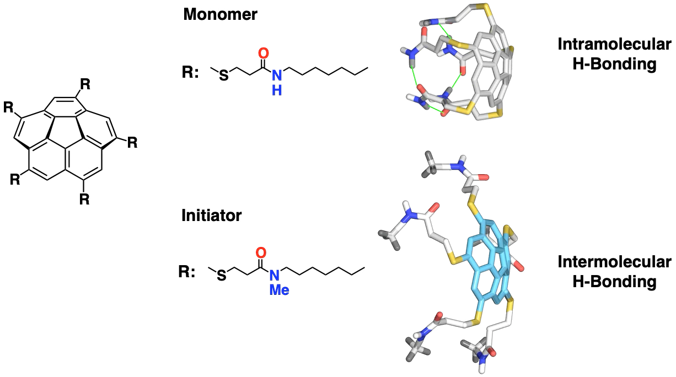
Figure 2. Molecular structures of the "Metastable Monomer" (top) and the "Initiator" (bottom).
"Metastable Monomer" with Suppressed Self-Assembly (Figure 2, top):
We designed a bowl-shaped corannulene derivative bearing five amide-containing thioalkyl side chains. In this monomer, the five amide groups form an intramolecular cyclic hydrogen-bonding network, stabilizing the molecule in a closed, cage-like conformation. This suppresses intermolecular interactions and keeps the monomer in a kinetically inactive state that prevents spontaneous self-assembly (polymerization) among monomers.
"Initiator" as the Reactive Starting Point (Figure 2, bottom):
As the polymerization initiator, we designed an analogue in which the amide nitrogen (N)atoms of the monomer side chains are methylated. Because N-methylationremoves the hydrogen-bond donors (N-H), the molecule cannot form intramolecular hydrogen bonds and instead adopts an open, extended conformation. Consequently, its carbonyl (C=O)groups—which serve as hydrogen-bond acceptors (proton acceptors)—are exposed outward in an active, reactive state.
3. How We Achieved It (2): Chain-Growth Supramolecular Polymerization Exclusively at the Chain Terminus (Figure 3)
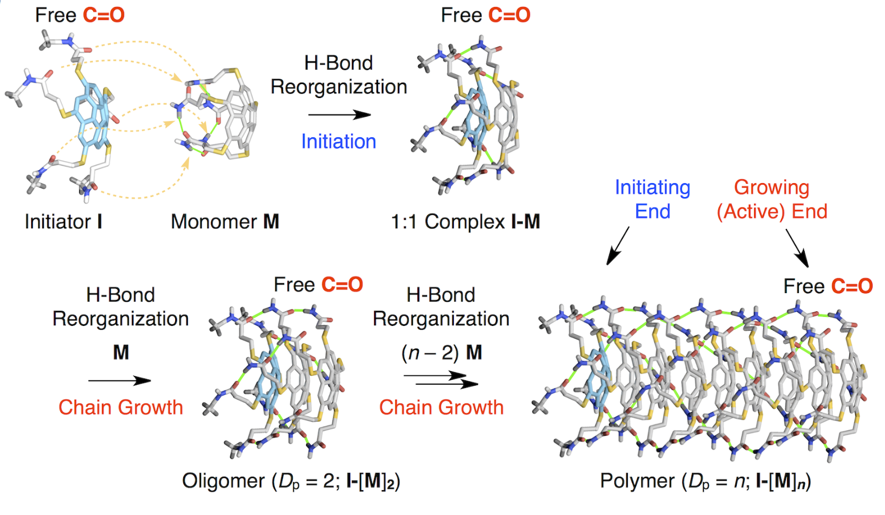
Figure 3. Chain-growth polymerization process of the metastable monomer triggered by the initiator.
(1) Initiation:
When the closed "metastable monomer" is mixed with the open "initiator," the exposed carbonyl groups (proton acceptors) of the initiator cleave the intramolecular hydrogen bonds of the metastable monomer and form intermolecular hydrogen bonds to yield a dimer.
(2) Regeneration of the Active Terminus & Chain Propagation:
Once the metastable monomer binds to the initiator and opens its conformation, its own carbonyl groups become newly exposed at the chain end. These exposed carbonyls then act as the next proton acceptors (active terminus) to bind the subsequent metastable monomer, allowing chain-growth polymerization to propagate unidirectionally in a domino-like manner.
(3) Prevention of Chain–Chain Coupling:
Because the opposite terminus capped by the initiator is N-methylated and remains inactive, undesired coupling between growing polymer chains never occurs.
By restricting the reactive site exclusively to one end of the polymer chain, we realized true chain-growth supramolecular polymerization and succeeded in precisely controlling polymer length via the monomer-to-initiator feed ratio for the first time.
3.What valuable advice and messages would you like to offer to youth researchers?
Today, investment in AI-related research and development is surging at a breathtaking pace. Yet no trend lasts forever; scientific fashions inevitably rise and fall, eventually giving way to the next wave. While riding the crest of a current trend may be advantageous for securing research funding, it is worth remembering that even the foundational research behind today’s AI revolution attracted very little attention at its inception. True pioneers—and the breakthroughs recognized by honors such as the Nobel Prize—emerge only by venturing into barren, uncharted territory where success is far from guaranteed. If you enter a field merely because it is fashionable, you will be left with very little once the hype fades. Instead, I strongly encourage you to follow your own intellectual curiosity and find a research subject that you can pursue with genuine passion, unswayed by passing trends.
欢迎各界学者和广大读者研讨交流!如您有交流合作意向,可通过邮箱和团队联系。